SUBMIT YOUR PRESENTATION PROPOSAL
Due to the high volume of submissions, selection notices will now be provided no later than March 13, 2026.
Invitation for Abstract Submissions
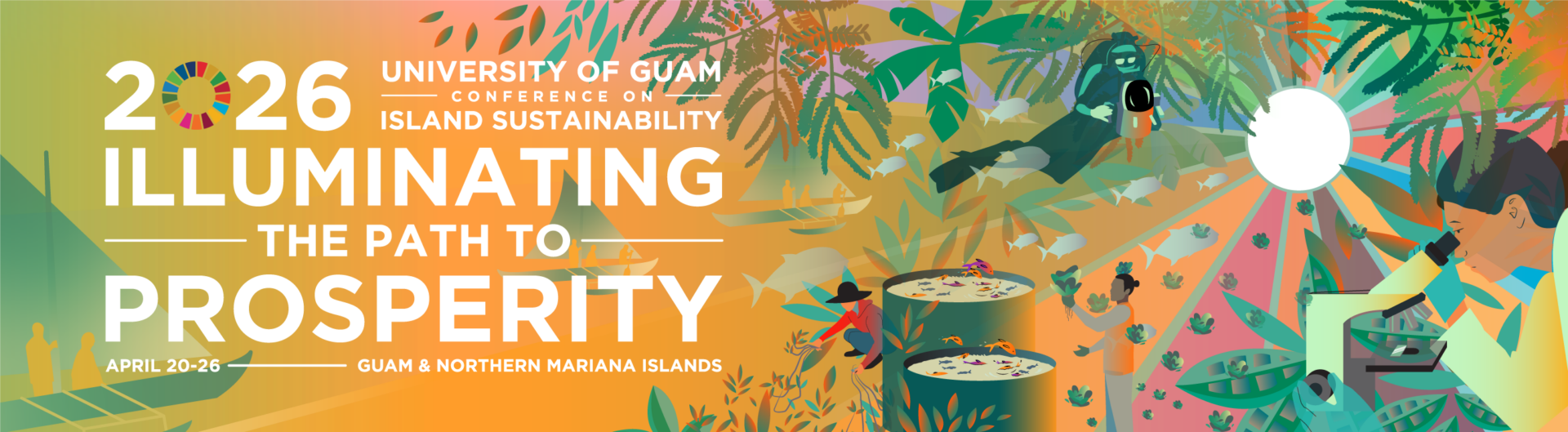
The annual University of Guam Conference on Island Sustainability is a blend of scholarship, advocacy, and action. We encourage diverse presentation and abstract proposals focused on the conference theme, “illuminating the path to prosperity,” from academia, government agencies, non-profit organizations, teachers, students, and the general community.
Call for Research:
Abstracts of current or recent research findings are requested. These abstracts should include a description of replicable methods that contribute to the understanding of island sustainability challenges.
Call for Action:
Abstracts for presentations that will inspire sustainable action in our communities are requested. These submissions should be evidence-based solutions or plans that will help address the challenges of island sustainability. Case studies may be included. Please include a statement in the abstract outlining an implementation plan following the conference.
Conference Tracks and Suggested Topics
The 2026 conference tracks align with Categories of Action developed by the Guam Green Growth (G3) Working Group to implement the 17 United Nations Sustainable Development Goals in locally and culturally effective ways. G3 is the most comprehensive public-private partnership ever created to achieve a sustainable future for Guam. As a founding member of the Local2030 Islands Network, Guam collaborates with other islands worldwide to create a sustainable global future. CIS2026 will convene islanders and their allies to exchange ideas and launch a wave of sustainability over the next year.
TRACK 1: Healthy & Prosperous Communities
Overview: In the CHamoru language, Guåhan means “We have.” As an island abundant in resources, our communities can be healthy and prosperous. Sustainable development requires reducing poverty and hunger, addressing the health and well-being of all population groups, and being innovative in how our society can promote local industries.
Main Actions: Increasing food security and expanding accessibility to local, nutritious food (community gardens, sustainable agriculture, and aquaculture); Creating an environment for innovative local industries that help reduce reliance on imports and reduce waste generation; Strengthening prevention efforts and programs that decrease substance use while promoting better health decisions, wellness, and affordable care.
Traditionally, our communities are centered around inafa’maolek- the value of making things good using a sense of reciprocity. This cultural value is essential to building a healthy, prosperous community.
Potential topics include, but are not limited to, the following:
Increasing access to essential services to vulnerable and marginalized populations
Increasing food security and accessibility to local, nutritious food
Protecting our community from disease while addressing high-priority health issues
Transitioning to the circular economy to design out waste and create new industries
Achieving increased visitors and revenue while implementing sustainable and responsible practices
Creating an environment for innovative cottage industries to reduce reliance on imports and reduce waste generation
TRACK 2: Educated, Capable & Compassionate Islands
Overview: A capable and compassionate island is enhanced when we apply relevant knowledge and develop tools that promote transformative education, encouraging the embodiment of amamåhlao as we teach moral and ethical boundaries within our familial, social, and community relationships.
Main Actions: Improving graduation rates; Developing supplemental curriculum and service-learning opportunities that focus on the locally relevant topics related to the SDGs to create pathways for next generation leaders, including place-based curriculum in core education and incorporating indigenous knowledge; Improving accessibility to education and workforce development trainings that also promote the creation of innovative and sustainable industries.
Prioritizing education, workforce development, and encouraging equitable and respectful treatment of all members of our society facilitates progress towards the goals of each person and our island. These conscious community practices allow us to provide for ourselves, contribute to our islands, and are built on the value of agofli’e’– to see the good beyond what may seem uncommon, without judgment.
Potential topics include, but are not limited to, the following:
- Engaging our community and K-12 students through innovative lessons and teaching strategies on issues of sustainability
- Building capacity in our region to address sustainability challenges
- Connect the dots for students to major in STEM, sustainability, and green technology fields, and ensure local jobs are ready and available for them
- Deploying effective educational outreach strategies to engage the community and inspire sustainable action
TRACK 3: Sustainable Homes, Utilities & Transportation
Overview: Our homes protect our families and us. Our utilities ensure we can be healthy, hygienic, and comfortable. Our transportation helps us to access our needs and sustain our roles outside of the home. Equitable access to innovative, safe, efficient, and affordable housing, electricity, water, and transportation is a universal human right.
Main Actions: Our collective responsibility to secure these resources for all centers on ageftao, where we provide for those with greater need.
Efficient systems that produce goods, reduce waste, and conserve resources encourage sustainable production and responsible consumption, embody a’adahi, where we have care for one another and have respect for our surroundings.
Potential topics include, but are not limited to, the following:
- Sharing innovations in sustainable building materials and design, including homes and infrastructure resilient to climate impacts and disasters
- Addressing the affordability of housing and reducing homelessness
- Exploring the current outlook and steps necessary for the 100% renewable energy future of islands · Programs or practices for residential and commercial consumers to use energy sustainably
- Transitioning to zero-emission private and public transportation
TRACK 4: Thriving Natural Resources
Overview: Islanders have a rich history of relying on the land and ocean to sustain us, wherein we practice respetu (respect) for ourselves and our environment. Currently, poor development practices, overfishing, land erosion, coral bleaching, invasive species, climate change, and other threats to our environment put our natural resources and biodiversity at risk. Developing long-term plans to use and manage our marine and terrestrial ecosystems sustainably will require actions rooted in traditional and modern sustainable practices.
Main Actions: Achieving the goals outlined in the Micronesia Challenge 2030 commitments; Protecting and effectively managing our fisheries; Ramping up watershed restoration and forest conservation; Fostering climate-aware and resilient communities.
Potential topics include, but are not limited to, the following:
- Innovations to sustain and restore island biodiversity
- Understanding coral reefs, coral-reef ecology, fish and fisheries biology, oceanography
- Climate change and environmental change outlook and solutions
- Restoring watersheds, ridge-to-reef connections, and reducing land-based sources of pollution
- Innovations in conservation, management, and restoration to promote healthier terrestrial, aquatic, and marine island environments
- Human dimensions and community engagement
.
TRACK 5: Sustainable Alliances
Overview: Achieving these ambitious Sustainable Development Goals by 2030 would be impossible if done without alliances. Aligning our efforts with local, regional, international, and global partnerships can help us accelerate reaching our goals. We can learn from the achievements of others and share our successes with those who are still joining the path. As a single island in the Pacific, we can have a larger impact on the rest of our oceanic region when we collaborate and work together.
Main Actions: To be engaged in local, regional, international, and global partnerships and forums to enhance our efforts to have a more sustainable, equitable, and prosperous future.
Through the value of mana’yuda (collaboration and cooperation towards a common goal), we understand that we have a responsibility for each other because our actions have direct, global consequences. By embodying this value, we learn from our collective achievements and share our successes with others as they consider joining in this effort.
Potential topics include, but are not limited to, the following:
- Strengthening our local, regional, and international partnerships to advance equity, prosperity, and sustainability
- Ongoing engagement and updates to strategic plans with regional partners
- Asserting involvement in local and regional fora such as the Micronesian Islands Forum, Pacific Islands Forum, and the United Nations
- Fostering the growth of academic research and support

303 University Drive
UOG Station
Mangilao, Guam 96913
Phone: (671)735-5631
Email: cis@uog.edu
seagrant@uog.edu
Contact Us
©2026 University of Guam
Sea Grant. All rights reserved.
303 University Drive UOG Station
Mangilao, Guam 96913
Phone: (671)-735-5631
Email: cis@uog.edu
seagrant@uog.edu
Contact Us
©2026 University of Guam
Sea Grant.
All rights reserved.